Duration
Sep, 2025 - Aug, 2026
What I Did
Supply Chain Management
Warehouse Management
My Role
Inbound & Outbound Manager
Supervisor
Company
-YQN LOGISTICS (Ellabell, GA)
-MW TECHNOLOGY LOGISTICS SAV INC
3PL Warehouse Operations & Service Design Intervention
This portfolio showcases the deep integration of service design and modern supply chain management. In the high-velocity environment of third-party logistics (3PL), warehouse operations frequently face challenges related to physical space constraints and multi-stakeholder collaboration. This project treats warehouse setup, spatial layout planning, and Standard Operating Procedure (SOP) optimization as a large-scale service design practice.
Project Goal
Led the end-to-end spatial and workflow planning for a newly established warehouse. By integrating service design methodologies, I optimized the Standard Operating Procedures (SOPs) for inbound and outbound processes, resolving on-site congestion and picking errors to comprehensively enhance operational efficiency.
Achievements
🔹 Data-Driven Spatial Blueprinting
Physical space is limited, but routing can be optimized. By analyzing historical volume data, we allocated maximum buffer zones for high-throughput destinations and strictly separated forklift and pedestrian traffic, resolving congestion and safety risks at the source.
🔹 Bridging Collaboration Silos through SOPs
We aligned the WMS system, PDA operations, and on-site human behaviors. By clearly defining the boundaries between Lumpers and Scanners and introducing AI-assisted dock scheduling, cross-departmental collaboration no longer relied on "unspoken rules" but on a logical service blueprint.
🔹 Parallel Workflow & Information Synchronization
By synchronizing information flow and specializing tasks, we eliminated the dead time spent searching for space, ultimately reducing inbound time by 40%.

Phase 1
Spatial Blueprint & Layout Planning (FBA)
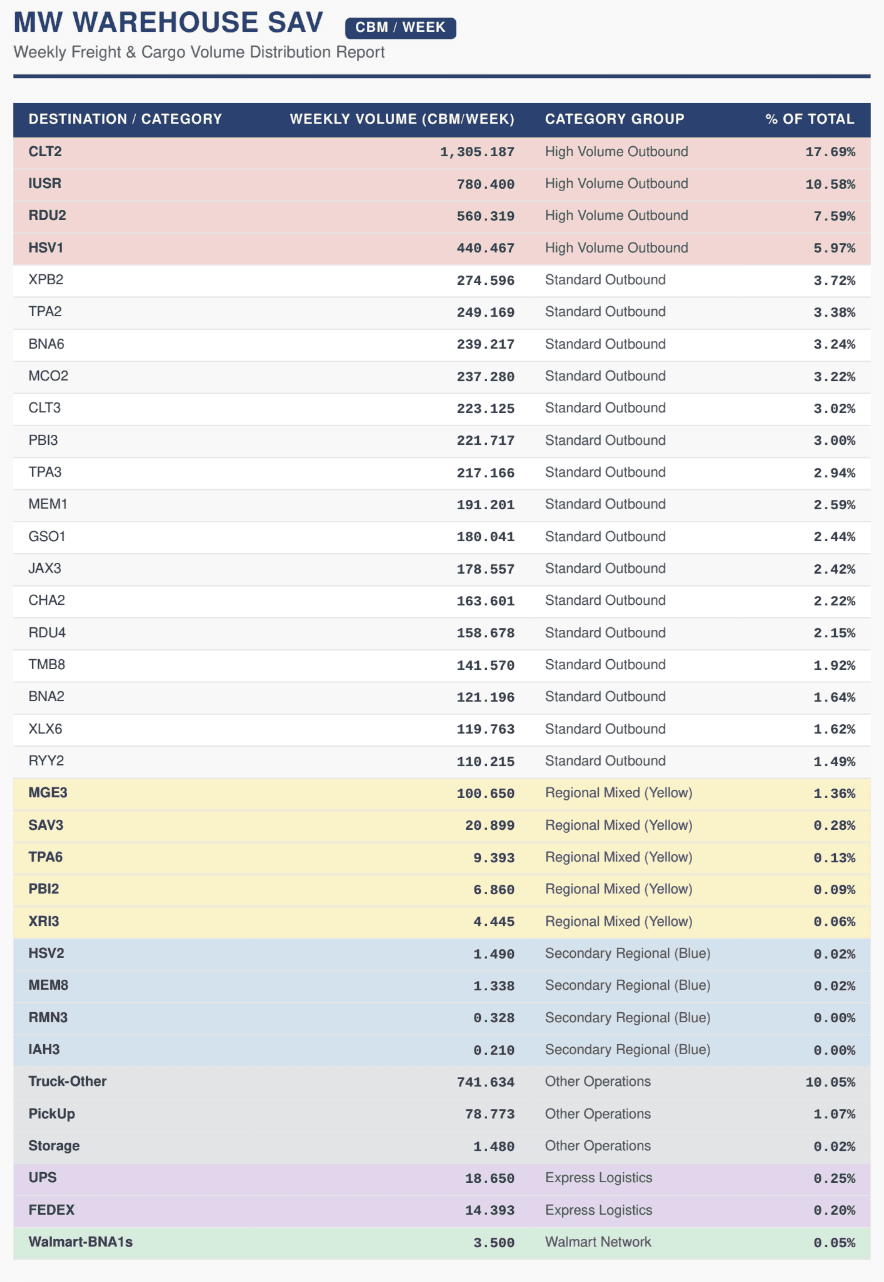
Spatial layout is more than just drawing grids; it is a data-driven service workflow design. I analyzed historical volume data across various shipping destinations to optimize the allocation of physical space and routing:
By analyzing volume data, I identified high-frequency and large-volume shipping nodes (e.g.,
CLT2,IUSR,RDU2as the top three).
In the Outbound area, I allocated the largest dedicated staging zones for these three destinations, ensuring sufficient buffer capacity for high-velocity goods and mitigating the risk of warehouse overflow.

Strictly delineated zones for INBOUND, OUTBOUND, and PICKUP, while establishing dedicated
OfficeandHOLD(exception handling) areas to quickly remove problematic items from the main workflow. Designed a clear FORKLIFT WAY to separate pedestrian and forklift traffic, enhancing on-site safety and reducing bottlenecks. Compared to the previous setup, this plan increases warehouse outbound efficiency threefold.
Phase 2
Service Blueprinting & SOP Optimization for Dropshipping
Dropshipping (B2C Express) is characterized by "high-frequency, small-volume, and fragmented" orders. Any lapse at a single touchpoint can lead to severe customer complaints and operational costs. By deconstructing the Management Process Matrix, I connected the WMS, PDA devices, and the behaviors of various roles (Lumpers, Scanners, Pickers, Verifiers) to map out a comprehensive service blueprint. Through behavioral design and foolproofing mechanisms, I ensured seamless collaboration across all upstream and downstream workflows.

Inbound: Controlling Chaos at the Source
Inbound is not just about unloading; it's about preparing for an efficient outbound process. In the SOP design, I reinforced the precise binding of "system information to physical goods" and clearly delineated role boundaries:
Standardizing Sorting Behaviors
Explicitly defined that Scanners are not just tallying items; they must supervise Lumpers regarding "Palletizing Consistency, Reasonable Placement, and Floor Stacking Height," ensuring safety and space utilization for the subsequent Putaway phase.System-Physical Asset Binding
Mandated that upon unloading, staff must use PDAs to scan and affix the "Pallet Container ID," perfectly binding the physical pallet to the system location. Any discrepancies (Good/Defective, Short/Over) must be instantly updated in the WMS to prevent anomalous inventory from entering the putaway stage.Parallel Workflow & Information Synchronization
During the inbound phase, I decoupled the traditional linear process into two parallel teams. One team focused on "location consolidation" within the warehouse, providing real-time updates via a shared cloud form. The other team utilized these exact "empty location coordinates" from the form to execute precise putaway. By synchronizing information flow and specializing tasks, we eliminated the dead time spent searching for space, ultimately reducing inbound time by 40%.
Outbound Express: Ultimate Foolproofing & Closed-Loop Dispatch
The core pain point of B2C dropshipping is "mis-picks and missed scans." I removed error-prone flexibilities from the Outbound SOP and hardcoded "foolproofing mechanisms" into the operational standards:
Algorithmic Routing & Task Filtering: WMS automatically generates pick lists based on outbound orders to optimize routes. An anomaly reporting mechanism was established (e.g., reporting to the manager if a picking task is < 10 pcs) to eliminate inefficient physical labor.
Pre-defined Exception Handling: Provided predefined solutions for frontline staff within the SOP to reduce cognitive load. For example, if a "Pallet ID is Lost," staff are instructed to "Find Item Name (SKU) on WMS Verification Panel," keeping the production line moving without interruption.
Dispatch Closed-Loop Verification: Staff must use a PDA to scan the Loading ID and bind it to the Vehicle No. The system automatically cross-checks for any "Pending Verification" items. Once dispatched, the SOP dictates "No Scanning after Dispatch," finalizing a 100% accurate, closed-loop outbound process.

SOP Optimization
To ensure rapid operational stabilization post-setup, I deconstructed front-end and back-end touchpoints to create an SOP service blueprint. This ensured alignment between system operations (WMS/PDA) and on-site staff executions.

Transforming Warehouse Operations: Aligning Data, Systems, and People
During the initial setup phase, managing massive inbound and outbound throughput presented significant challenges, primarily "physical space constraints" and "collaboration silos among multiple stakeholders" (Managers, Lumpers, Scanners, Pickers). To address this, I treated the warehouse as a large-scale "service touchpoint" and introduced service design thinking to seamlessly bridge operational data, the WMS system, and on-site human behaviors.

Recent Projects
Projects